Category: Anatheos

  • Of Mage-Queens and Marches

    The title “Mage-Queen”, as used in the Marksvar, does not necessitate political authority. For Tarvin Derek, it absolutely did.

    The Marksvar, or the March, refers to the territory that today is split between Westmark, Eastmark, and Leevara. A Mage-Queen (or Mage-King, though nearly all famous persons to hold this title have identified as female) is a powerful sorcerer who is said to be chosen by The Five. To attain this title, the person must be recognized by an assembly of all village leaders in the March.

    The title of Mage-Queen carries spiritual significance. While they have never held concrete authority, they are considered to speak for the spirits and their counsel is often sought for any weighty matter. Throughout the recorded history of the territory, up until annexation, at least one Mage-Queen was alive around a third of the time. (There was a brief time in which there were two Mage-Queens, whose escapades are better suited to tabloids than history books.)

    Tarvin Derek is known as “the last true Mage-Queen” and is by far the most famous, being the last person to hold this title before the March became part of the Duskhyn Confederation.

    Since the title became associated with hostile sentiment, it was many decades before the people of the Marksvar elevated another Mage-Queen, though several worthy candidates presented themselves over time. Modern Mage-Queens are appointed in much the same manner as always, but the rule of lords and governors greatly diminished their soft power.

    The Third March War

    The First and Second March Wars were largely power struggles between different factions within the Marksvar. The Third March War also began this way, but was unique in that it ultimately brought the entire March together to flip off the Confederacy.

    Tarvin Derek was a local sage from what is modern day Leevara. As the conflict began to build, it is said she received a vision from the spirits wherein Easterners (the Telosi people) took advantage of their division to conquer the entire Marksvar. She began to travel and spread her word of warning to other towns. Reception was mixed.

    It became apparent to Tarvin and her allies, including one Oma Leevara, that her message would be better received were she recognized as Mage-Queen, and thus a campaign was launched. She continued to be met with resistance until she worked an unprecedented wonder of magic before a crowd in the city of Atonbeck. It was later revealed that her work was aided by technology provided by the Empire of Bostia.

    After being confirmed as Mage-Queen, Tarvin hit the ground running in drumming up martial support for a “preemptive assault” on Duskhyn. Oma Leevara did not like this development and turned against her. He began working with the Duskhyn lords to undermine Tarvin.

    With pressure from the east, and now from the south with Oma’s faction, Tarvin was ultimately contained to Atonbeck, where a months-long siege ultimately decided the war in Duskhyn’s favor.

    With their leader defeated, the March conceded to annexation by Duskhyn. Oma was granted his own territory, the province of Leevara. The rest of the Marksvar became one massive province, which was soon split into Westmark and Eastmark.

    Fifty years later some guy would get mad and move the seat of the Grand Council to Goodhope, Eastmark. But that’s another story.

    The Five

    The spiral emblem shown on Tarvin’s chest refers to The Five. The Five States, or Five Elements, are the basic forms by which Marker tradition defines all things. These five states of being are typically described thus:

    • That which was (air),
    • That which is (earth),
    • That which shall be (living things),
    • That which is eternal (water), and
    • That which should not be (fire).

    The Five are a tenet of old Marker spiritualism and are still revered by many contemporary Marksfolk, and also by rebellious Telosi youth.
  • Linguistics of the Duskhyn Confederacy

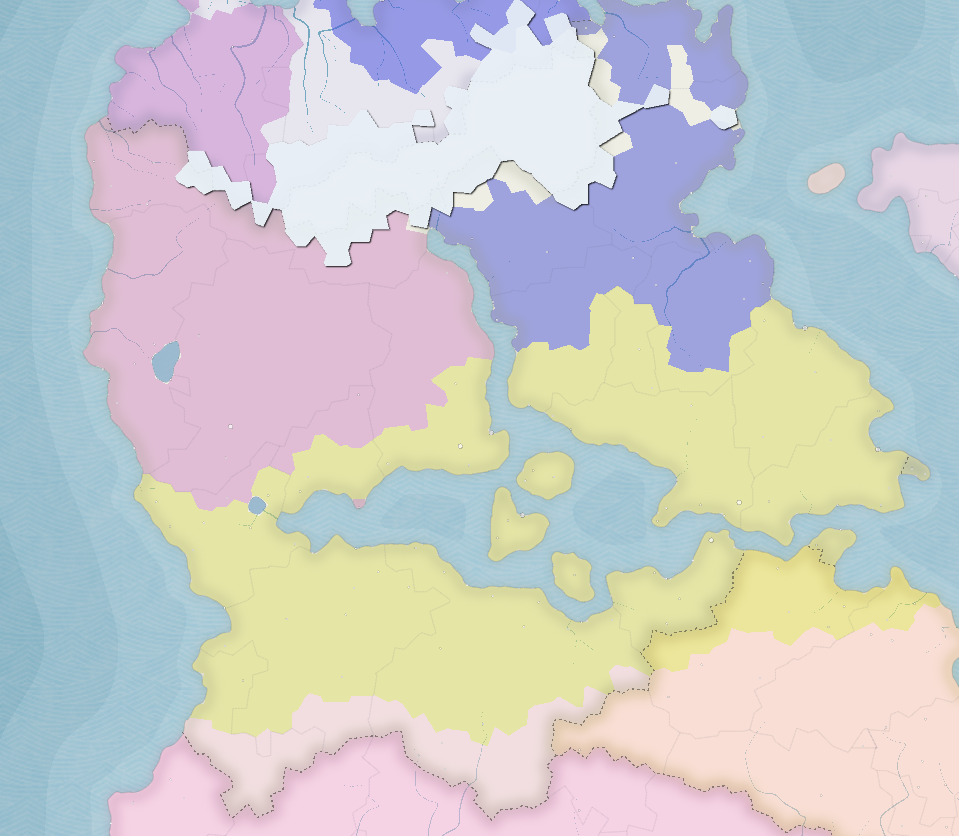
    The official language of Duskhyn is Telosi, derived from the languages spoken by peoples surrounding the Telos Sea. This language is used in all official documents and in most trade applications, so most people within Duskhyn or who engage in regular business with them speak it.

    Old Telosi was one of the three major linguistic families, dominating most of the southern provinces. In the northwest, from Westmark onward, two different forms of Marker are spoken in addition to Telosi. Northeast of the Telos Sea, particularly among the more isolated inland groups, most people speak some form of Bed’oath as a first language. Fluent Telosi speakers in this region are a slight minority.

    Linguistic map showing Telosi (gold), Marker (pink), and Bed’oath (blue) regions.
  • Economic development of northern Duskhyn

    When the Duskhyn Confederation formed, the wealthier and more organized states in the southwest had the greatest influence on its structure. Said states already had strong central governments under a single lord, so transitioning to being provinces under governors was mostly a matter of vocabulary.

    The northern provinces, notably Frostmoor and Everdawn, were not so well prepared. The territory that made up these two did not have any government above those of individual villages and nomadic tribes. They had few natural resources available to them and in some cases had to trade for basic necessities. Now, all of a sudden, they were arbitrarily grouped together under a couple governors most of them had never had any dealings with.

    With no preexisting structurers to build upon, the new lords of Frostmoor and Everdawn found themselves saddled with a number of responsibilities under the Duskhyn Charter, and zero funding or infrastructure with which to carry them out.

    What sets the two provinces apart is how they have gone about remedying the situation. The House Frostmoor’s approach has been building from the ground up—with little in the way of currency circulating through the territory, they have worked out trade arrangements between villages to better allocate goods, and exchanged roads and infrastructure for resources. Progress has been slow but measurable, though Frostmoor is still considered to be the overall poorest province of Duskhyn.

    House Everdawn took a more aggressive approach. They actively recruited merchants to relocate to their ports. Their pitch was based on the as yet underutilized trade markets of the inland cultures—who were all but fully dependent on them—but also a very low tax rate, especially compared to the more established provinces like Kingsport, Telos, and so on. Their efforts were successful, and over the next few decades, the twin ports of Mountport and Dawnsea became bustling trade hubs.

    However, precisely because of the low tax rate, and the absolute power these great merchant companies now held, very little of the newfound wealth could be captured by the government of Everdawn. The provincial leadership found itself unable to administrate much of anything within Mountport and Dawnsea, much less in rural areas. The merchant companies took matters into their own hands, forming their own private police forces, roads, and infrastructure. The inland residents have been more or less forced to fend for themselves, angling for the scraps that the governor has left for them.

  • The Symbol of House Lucia

    After Telos, the last god, was laid to rest, Lucia cast aside her divine raiment. That armor, timeless in the same way as its owner, is now preserved in the provincial treasury of House Telos.

    Instead, Lucia adopted far more mundane armor, and has gone through quite a few sets over the years. Many of these were gifts from various nobility. But her first gifted armor, and one her finest, came from Old Bostia.

    lucia

    The best craftspeople of Bostia——long before its imperial rise and fall——designed a new “house” symbol to engrave in the armor, in the style of Duskhyn lords and ladies. The spears pointed downwards represent justice enacted on mortals by a higher authority. The wavy sword pointed upwards represents the flaming sword with which Lucia slew most of these higher authorities.

    The circle of three intertwined threads are an ancient Duskhyn symbol of eternity. Each thread represents each part of the day cycle—morning, evening, and night.

    In the same way that Lucia never formally accepted the title of “Lady”, she never officially adopted the symbol in reference to herself, but it nonetheless caught on among mortals and came to be permanently associated with her.